Homage to Catalonia (1938) was written after Orwell´s participation in the Spanish Civil War. He went to Barcelona in 1936 to join the pre-revolutionary uprising against the coup d´etat performed by Franco´s troups. He believed that there were enough conditions in Spain for a revolution against Fascism and Capitalism. “Down the Ramblas, the wide central artery of the town where crowds of people streamed constantly to and fro, the loudspeakers were bellowing revolutionary songs all day and far into the night” (Orwell 1938: Chap. I)
Orwell let himself be carried away by the city´s atmosphere. He joined the POUM (Partido Obrero de Unificación Marxista) and went to the Huesca front to fight against the Fascist troups. On his return, Orwell found that the classless society he encountered in Barcelona at his arrival had turned into a bourgeoisie “fat prosperous men, elegant women, and sleek cars were everywhere” (Orwell 1938: Chap. IX).
He also found that the groups not cooperating with the Communists were accused of being Fascists. Stalinists had also began to attack Socialist and Anarchists who refused to back the Soviet line. The PSUC (Unified Socialist Party of Catalonia) even used brutal methods to suppress those against the Party. None of this, was being reported in the English media at the time. The war in Spain “was being distorted for political reasons”(Rodden 2007:5) in order to serve Left-wingers in their diffusion of Socialist propaganda. This foreshadowed some of the significance that language was going to have in Orwell´s Animal Farm and in 1984.
Certainly, the Spanish Civil War was far more complex than Orwell had expected. In England, the war was being portrayed as a fight of the proletariat against the Fascist regime, which helped the Left wingers support their cause for Socialism. However, Orwell tells us in Homage to Catalonia that the Spanish proletariat were too concerned about defeating Franco and never got rid of the authority of the Capitalist State. In addition to that, the Socialist, Anarchists and Communists groups were confronted, making even easier the triumph of Franco.
Crick (1941:20) in the introduction to The Lion and the Unicorn tells us that Orwell regarded Revolution “as a process and not as an event; it need not be violent to break up the old class structure, but it could have violence thrust upon it by resistance to socialist Parliamentary legislation“. This was obviated in the Spanish Civil War where the Revolution focused on fighting against Fascism and nothing else. This deeply disappointed Orwell. “The working class believed in a revolution that had been begun but never consolidated, and the bourgeoisie were scared and temporarily disguising themselves as workers”. (Orwell 1937: Chap. IX)
By and large, Orwell witnessed the collapse of a Revolution. Moreover, the workers weren´t organised, there were no ideas about changing work conditions, or principles on which to build on a new and more egalitarian system or society. This was of major importance for the author as he estated it himself in The Lion and the Unicorn. In fact, many scholars, Crick and Rodden among others, discuss that “Orwell´s emphasis on egalitarianism is what separated him from many of his fellow socialist”(Crick 1941:5). However, he was very concerned about the abuse of power and feared the neglection of the proletariat´s needs by greedy leaders.
Homage to Catalonia marks a starting point in Orwell´s narrative. Thanks to his experiences in the Spanish Civil War, he acquired a particular and social perspective about Socialism, Fascism, Totalitarianism and Revolutions. This is also a product of his time, as the Second World War was also approaching and the revolutionary upheaval was evident in Europe.
In 1945, right after World War II, Orwell published Animal Farm, and three years later, he published 1984. Both narratives´ main theme is about tyrannical governments. Orwell is especially critical with totalitarianism, and the Soviet communists seem to have inspired both novels.
There are three center points in these novels that can be related to Orwell´s experience in the Spanish Civil War:
1) Language:
Language is used to manipulate and control people. Orwell had already experimented in the Spainsh Civil War that some depictions of reality are made to suit political purposes, and feared that “objective truth was in danger of disappearing”(Rodden 2007: 5). The official version of events was being accepted without questioning, but it existed a breach between reality and that being told. Moreover, censorship too threaten to empty the political discourse in the mass media.
Orwell said: “One of the most horrible features of war is that all the war-propaganda, all the screaming and lies and hatred, comes invariably from people who are not fighting” “(…)It is the same in all wars; the soldiers do the fighting, the journalists do the shouting, and no true patriot ever gets near a front-line trench, except on the briefest of propaganda tours“(Orwell 1938: Chapt. V).
In 1984, WAR IS PEACE, FREEDOM IS SLAVERY and IGNORANCE IS STRENGTH are some of the mottos used by Big Brother to control people´s independent thinking and distort reality. Furthermore, Winston works at the Ministry of Truth, altering old newspapers “scraped clean and reinscribed exactly as often as necessary” (Orwell 1948: Chap V). He worked manipulating the truth to suit the government needs.
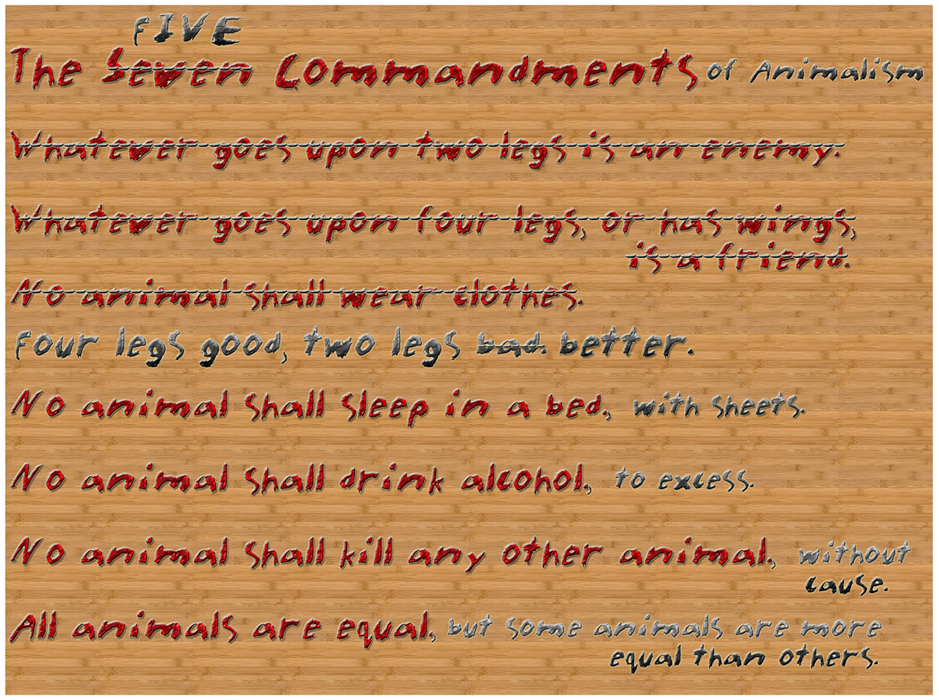
In Animal Farm the commandments are amended also to suit political needs:
Four legs good, two legs bad ——————— Four legs good, two legs better
No animal should sleep in a bed —————– with sheets
No animal should drink alcohol —————– to excess
No animal shall kill any other animal ———– without a cause
All animals are equal —————————— but some animals are more equal than others
2) Power:
The strive for power can betray the ideals of the Revolution. “Absolute power corrupts absolutely”. In Animal Farm, the pigs become greedy, corrupt and selfish. But in both novels, fear is exercised to control people, threatening them with death sentences or torture which reminds us of the Communist Party´s fascist repression methods against dissidents in Homage to Catalonia.
Moreover, people and animals are forced to work long hours, and left with little pleasurable time, this way they are more productive for the economic machine, satisfying the greedy needs of their leaders. In Animal Farm, the animals are promised better working conditions if they increase productivity, which actually makes them slaves of the productive system.
As Orwell narrated in Homage to Catalonia, a similar image comes to mind during the Spanish Civil War: “Every move [by the Communists in Spain] was made in the name of military necessity, … but the effect was to drive the workers back from an advantageous position and into a position in which, when the war was over, they would find it impossible to resist the reintroduction of capitalism”. (Orwell 1938: Chap. V)
This coincides with the motto in 1984 of FREEDOM IS SLAVERY. In Animal Farm, the animals are forced to work longer hours in order to improve their working conditions. In Homage to Catalonia, the workers are tricked to believe that defeating Franco and going back to normal – back to their previous situation – is the most important thing, and this way, they forget about their Revolution and their vindications for an equalitarian society.
3) The role of people:
People´s lack of organisation and involvement contributes to the failure of the Revolution in Animal Farm. Animals are kept ignorant and rely on the pigs for knowledge and education. In 1984, people are kept under the supervision of the State and there is no free-will or freedom of expression. In both stories, the criticism is towards the leaders who have absolute power and a passive population under their power. Orwell´s solution for avoiding this type of situations is to let people participate in politics in order to avoid totalitarian governments. For instance, in Homage to Catalonia the State is unchallenged and the revolution fails since the population are content to return to normal. They are slaves of the little commodities and privileges they have, especially the bourgoisie, and prefer to stop going further with their fight.
Orwell´s works have to be read keeping in mind the political circumstances of his time. For instance, Spain embittered Orwell and made him pessimistic about the future. He feared that Europe was drifting toward and “imperialistic war which would see the eventual triumph of some form of Fascism” (Rodden 2007:6).
Although his two last stories, Animal Farm and 1984, are written as fiction works and therefore have been misinterpreted by many, they have to be read as a warning of the perils of absolute power and the means to obtain such power. In Homage to Catalonia, the reader encounters a more straight forward tale about Orwell´s political ideas. Although his most powerful political statements come in the form of the two fiction novels. In both, there is a depiction of two dystopian societies where totalitarian governments rule and where the people had been tricked or brainwashed to support their governments.